
About A Country Doctor
Aktualisiert: 14. Apr.
by Harald Salfellner
It is something very special to
have a house of one’s own.
Franz Kafka

Crystal Clear Prose
After a two-year hiatus, Kafka enjoyed a fresh outpouring of creativity in the peace of Golden Lane during the winter of 1916/17, and wrote a series of prose pieces. These included the eleven stories that made up the bulk of the volume A Country Doctor in 1919/20, although the exact time of writing is not known for all the stories.

Two of them undoubtedly date from earlier: the allegory Before the Court from the Trial manuscript, published in the Jewish weekly journal Selbstwehr (Self Defence) back in 1915; and A Dream, a story written between August 1914 and July 1916, which was first published in mid-December 1916 in a Selbstwehr anthology entitled Das jüdische Prag (Jewish Prague) and which subsequently appeared in the Prager Tagblatt on 6 January 1917. The title story A Country Doctor, and the prose pieces In the Gallery, The Next Village and A Fratricide, were written in Kafka’s new octavo notebook, which served him as a literary jotter between mid-December 1916 and around mid-January 1917, but which sadly does not survive. He probably wrote the stories Jackals and Arabs and The New Attorney in February 1917. An Old Document, An Imperial Message (from The Great Wall of China) and possibly also Eleven Sons were written in March, although the latter is hard to date. In early April 1917, Kafka set down A Report for an Academy on paper, followed by Concern of the Head of a Family which must have been composed prior to August. This bundle of writings was concluded in late April with the story A Visit to the Mine.
In spring 1917, Max Brod, a convinced Zionist, corresponded with Martin Buber, the philosopher of religion, who lived in Germany and had published the monthly journal Der Jude (The Jew) with Salman Schocken since April 1916: “You should write to Kafka regarding literary contributions. He has recently written many lovely little prose pieces, legends, fairy tales.”1 Buber asked the author for manuscripts by return of post, and so on 22 April 1917, Kafka sent twelve pieces to choose from, which he intended to publish later as a collection entitled Verantwortung (Responsibility). Buber selected the stories Jackals and Arabs and A Report for an Academy. Kafka welcomed the possibility of publication in the Zionist journal and flattered the publisher: “So I will be in the ‘Jude’ after all, even though I always thought it impossible.”2 All the same, he rejected Buber’s suggested overall title of Gleichnisse (Parables); the two texts were to appear under the modest umbrella title Zwei Tiergeschichten (Two Animal Stories).

Several of the prose pieces written in the Golden Lane were not destined to form part of the Country Doctor. These include a parable, which Max Brod included in the 1931 collection The Great Wall of China entitled The Bridge, and the five sketches for The Warden of the Tomb that he jotted down in his first octavo notebook, and which his friend first published in 1936.
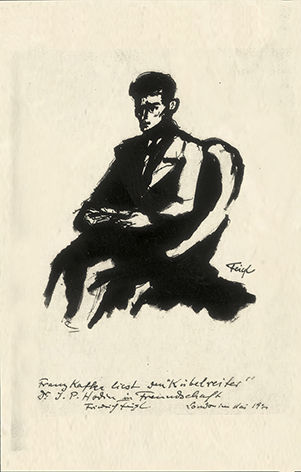
The story The Bucket Rider, inspired by the coal shortage, was probably written in late January; Kafka initially planned to include it in the Country Doctor collection, and recited it in February 1917 at a literary get-together in Oskar Baum’s flat. The Prague artist Friedrich Feigl was also present and would, decades later, paint the famous portrait Kafka liest den Kübelreiter (Kafka reads The Bucket Rider) from memory. In the end, Kafka withdrew the text at the proof stage and it did not make it into the Country Doctor. Kafka wrote the piece later known as To All My Household in February 1917, and the story The Knock on the Manor Gate in the last two weeks of March – this too was initially untitled. Kafka’s fragment The Neighbour, as it was later called, can be dated to April 1917, and mentions the “miserably thin walls” separating the first-person narrator from Doctor Felix Knoll (who, in fact, lived quietly next door), as can the prose piece A Crossbreed, which was first published on 27 March 1931 in Willy Haas’ periodical Die literarische Welt (The Literary World). Notes and fragments for The Hunter Gracchus, which Kafka set down in December 1916 were written over an extended period.
The handwritten draft of the most significant of these texts, the surreal title story A Country Doctor, has sadly not survived. It is also uncertain whether Kafka was thinking of his favourite uncle when he wrote the story in December 1916 or January 1917: Siegfried Löwy was a doctor in the small provincial town of Triesch (Třešť) in Moravia, and had celebrated his 50th birthday in early 1917.

The story has been excessively over-interpreted, but one of its many motifs is the deep, bleeding wound that fascinates the patient and the doctor alike. Kafka himself saw the story as a premonition of his own mortal wound, which appeared in a haemorrhage one night in August 1917: “I predicted it myself. Do you remember the bleeding wound in the ‘Country Doctor’?”3
You can read the full afterword in our Prague edition of Kafka’s A Country Doctor.
Notes
1. Max Brod, 7.4.1917 to Martin Buber, Br III, p. 639.
2. Franz Kafka, 12.5.1917 to Martin Buber, Br III, p. 299.
3. Franz Kafka, 5.9.1917 to Max Brod, Br III, p. 314.