
Kafka’s Schooldays
from Harald Salfellner
We don’t know all that much about Kafka’s time at school, and what little we do comes from his letters, particularly the Letter to Father, written in 1919. Classmates and contemporaries including Hugo Bergmann, Gustav Janouch and Hugo Hecht have added a few reminiscences, written after his death and ascent to the status of literary icon. Max Brod, Kafka’s tireless herald, offered a few further insights. Researchers such as Hartmut Binder, Anthony Northey and Klaus Wagenbach have discovered other titbits in the archives. Many of the details in the endless biographies, however, are speculative, coloured by ideology, or sheer mindless plagiarism. As a result, we have little more than a blurry image of the schoolboy Kafka.

In what was once the apothecary district, between the Old Town Square and the Small Square, stands a building that is at heart a late-Gothic gabled house, distinguished by sgraffito images of Biblical and classical tales.
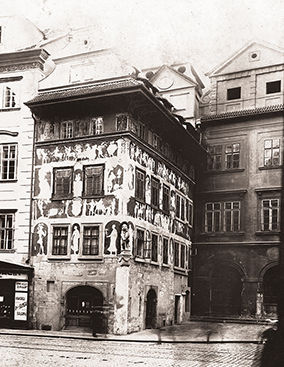
In the 19th century, there was a pharmacy on the ground floor, selling potions and salves at the sign Of the White Lion, immortalised by the lion on the corner, holding a coat of arms in its paws. This was followed in the second half of the century by a tobacconist, retailing cigars, newspapers and other goods. Retail in Italian is al minuto and the name Zur Minute, or Minuta for short, has been attached to the building ever since. The striking artwork had been covered over by the time Mr and Mrs Kafka and their six-year-old son moved into the three-room flat on the first floor in July 1889, and the arcade was closed off, as it would remain until 1938, then the far-distant future.

Kafka lived in the house At the Minute until well into his secondary school years. The cramped flat was his playground, day in day out, so it is no wonder that Franz could be tempted outdoors in sunny weather, to the square a few metres away. The boy expanded his territory only gradually, exploring the streets and squares close by. From an early age, he admired the Town Hall clock, the orloj in Czech, with its astronomical dial and allegorical calendar showing the twelve months and the zodiacal symbols; he would have seen the Grim Reaper, the knights and the other figures beneath the Gothic canopy. How often the lad must have looked up to the Apostles high above, doing their laps as the hour struck!
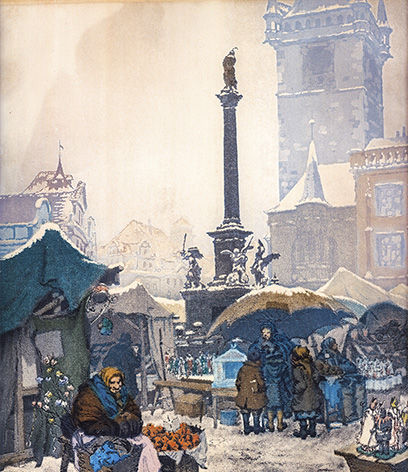
He also watched the golden cockerel, whose hoarse crow he heard so often. A few metres further on, the Baroque Marian Column towered over the Square; the boy would sit on its steps and watch the hurrying passers-by. The booths and stalls of the St Nicholas market would stand here in Advent, Czech traders selling sweets and hot chestnuts to those walking by.
On some days, the boy and his nursemaid would walk hand in hand down Eisengasse [Železná ulice] to the Graben [Na příkopě] and on across busy Wenceslas Square, down Melantrichgasse [Melantrichova] to the Gallus Market [Havelsky trh]. On the other side of the town hall, Franz knew, was the mysterious world of the old Jewish District, where his father occasionally went to the Zigeuner [Cikánova] Synagogue. It wasn’t far to the large townhouse on Plattnergasse [Platnéřská ulice], where his worthy Uncle Angelus lived, and soon after that, the maze of streets opened out onto the Charles Bridge with its many statues of saints. Over the parapet, Franz would see the Hradčany, the old imperial castle. Another time, he might walk at the nanny’s side down Zeltnergasse [Celetná], past the Sixt House, where he had also briefly lived with his parents. Then on, past elegant shops and shop windows to the Gothic Powder Tower. He walked through more distant districts with his parents on Sunday strolls. These included the Lesser Town and Laurenziberg [Petřín Hill], or via the Chain Bridge to the Chotek Gardens beneath the Belvedere, high above the roofs of the Old Town. Sometimes, Franz and his parents visited his grandfather at 9 Gerstengasse [Ječná] (II-1433), a few hundred metres from Charles Square. The boy loved the soft buttered bread his grandmother would give him.

It was from the house At the Minute, the centre of his world, that the tiny lad first made his way to the Imperial and Royal German Language Boys’ Primary School in Prague’s Old Town on Monday, 16 September 1889. His mother had come with him to 16 Fleischmarktgasse [Rybná] and was now waiting outside the classroom. She had an acquaintance there in her neighbour, Mrs Hecht, who was now sitting beside her. Class teacher Hans Markert showed Franz and the other children in his year to their seats on the wooden benches. After a few suitable words, spoken from beneath the portrait of His Imperial Majesty, the boys were released back to their waiting mothers’ care. Frau Kafka and Frau Hecht walked home, side by side, their sons Hugo and Franz now fully-fledged schoolboys.
It had only been a brief ceremony, but it had marked an important turning point for Kafka: the proverbial serious side of life had begun, yet he was drawn by unknown worlds beyond his narrow parental home. A world of laughter lay ahead of Kafka, “with a merriment that might only be granted to children on their primary school benches”.1 It was, however, also a time of fear: “I’d never get through the first year of primary school I thought, but I managed and even won a prize”.2
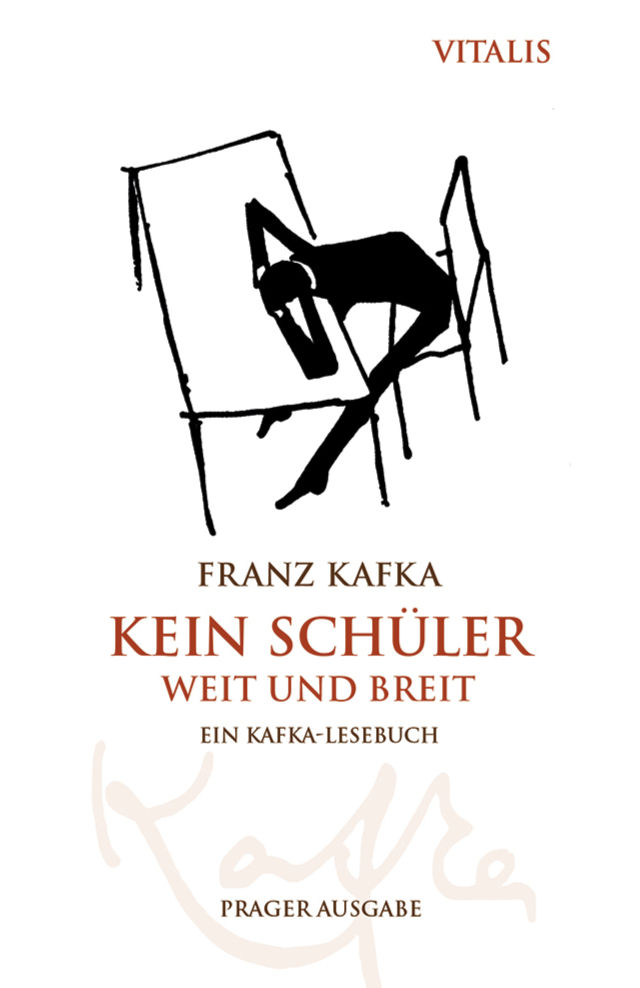
You can read the complete afterword in our school reader Kein Schüler weit und breit [There is No Pupil Far or Wide]
Dr. med. Harald Salfellner, Ph. D is a publisher, medical historian and author with a particular interest in Austro-Bohemian cultural history and the Prague author Franz Kafka.
Notes
Franz Kafka on 8/9 January 1913 to Felice Bauer, in: Br II, p. 29.
Franz Kafka: Brief an den Vater, in: NS II, p. 196.


